
Keeping Climate Scenarios Alive: From Disclosure to Decision-Making
Apr 17
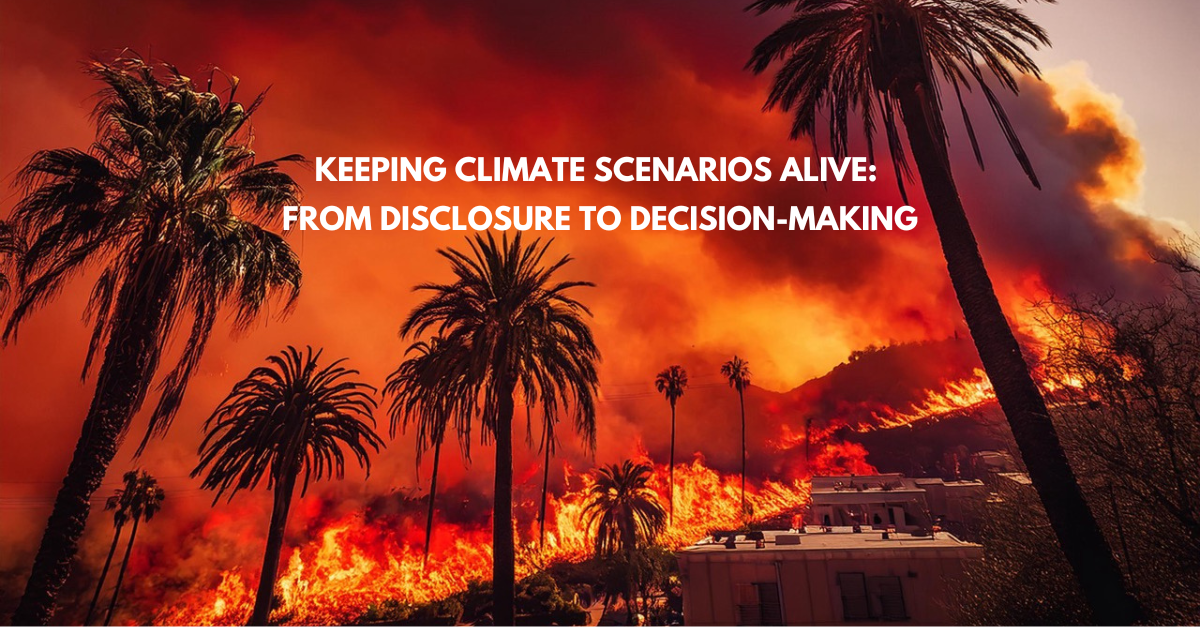
Not even three months into 2025, we have seen LA wildfires, record ocean heat, warnings of oceanic current collapse, and political retreat from climate action. These aren’t isolated blips; they’re flashing red lights on the dashboard. The climate isn’t changing—it has changed. Add in a healthy dose of fragility in geopolitics and you have a very uncertain world to navigate. Scenarios can help organisations cut through this uncertainty, tracking signals that indicate whether we are heading toward a crisis, a transformation, or a tipping point. They aren’t just tools for disclosure; they are essential for adaptation and resilience in a world where the unexpected is becoming the norm.
Empty space, drag to resize
“How did you go bankrupt?” Bill asked. “Two ways,” Mike said. “Gradually and then suddenly.” – Hemmingway (1926)
Empty space, drag to resize
Climate scenarios are not just for disclosure
While the drivers of developing climate scenarios often start with disclosure, their value extends far beyond regulatory compliance. Once crafted, these scenarios should not be left to gather dust in a report—rather, they can be dynamic, evolving tools that help organisations navigate uncertainty. A scenario is not just a snapshot in time; it is a living framework that should be continuously tested against real-world developments.
If you're monitoring the signals, you're paying attention to how the external environment is changing” Tom Chermack (2022)
Empty space, drag to resize
Tom Chermack, a leading expert in scenario planning, highlights that scenarios should function as an organisation's "radar" - constantly scanning for signals that indicate whether a given future is materialising. These signals are critical because they allow organisations to move beyond static plans and into proactive strategy-making. Instead of treating scenarios as hypothetical narratives for disclosure, they should be actively monitored to determine whether reality is aligning with one scenario over another.
The climate "what ifs" of 2025?
Policy decisions, economic shifts, technological breakthroughs, and physical climate changes can dampen or amplify climate change risks and they do not occur in isolation - they interact in complex and often unpredictable ways.
What climate-related plausible outliers may unfold this year? What if an ARKStorm-scale event strikes California, flooding millions out of their homes and sending economic shockwaves through insurance and real estate markets? What if COP30 in Belém collapses into a mass walkout, accentuating a deep global divide on climate finance and mitigation commitments? What if a climate-driven pandemic emerges, triggered by thawing permafrost or ecosystem disruptions?
We don’t know exactly what will unfold—but we do know that impactful climate drivers will emerge, and organisations that fail to identify and monitor signals risk being blindsided.
Scenarios remain an under-utilised tool in exploring these interdependencies. They allow organisations to test their strategies against risks that may otherwise be overlooked. Beyond tracking which future is emerging, signals supported by clear planning and decision making enable organisations to be agile and adapt quickly. Regular reviews of scenarios ensure they remain relevant. Not all changes require a complete overhaul of scenarios, but major deviations - such as abrupt policy reversals, extreme climate shocks, or unexpected technological leaps - should trigger structured reassessments.
In short, scenarios should be embedded in decision-making, not just disclosure. By identifying and tracking signals, organisations can anticipate change, challenge their strategies, and stay ahead of the curve in an increasingly volatile world.
If January’s events are the opening act, then the rest of the year will likely test assumptions in ways we haven't yet considered.
Empty space, drag to resize
*Please note: The views expressed in this document are those of the author(s) and do not necessarily reflect the opinions or positions of the organisations they represent.
AUTHORS
Donovan Burton
Climate Risk Specialist
Informed.CityTM
Informed.CityTM